

It’s the Holy Grail of shooting performance…
That “rapid fire” mag dump where…
… your pistol screams like a “machine gun”
… the barrel stays flat and locked on-target
… and every single bullet hits center-mass in a nice 1″ shot group.
And hey, I get it…
Every gun-owner dreams of that kind of accurate “combat burst”.
I mean, let’s face it…
It isn’t just impressive – it can even save your life if you ever have to stop a real threat.
But here’s the part most shooters never figure out…
You Don’t Get “Rapid-Fire Fast” With Fancy Drills… YouTube Theory… Or Rushing The Process. Instead…
Here Are 3 Simple Training Tips That Can Make YOU The “Rapid-Fire Gun Guru” At The Range…

Here are the 3 things I’ve found that make the biggest difference when it comes to shooting “rapid-fire fast” and staying on target…
1. “Combat Accuracy”
Let’s get this out of the way first…
You’re not going to run an entire mag in rapid fire mode and still get “one hole” shot groups.
That’s like trying to change a tire without getting your hands dirty.
(Not gonna happen.)
But that’s not the goal anyway.
The real goal of rapid fire (especially in defensive scenarios) is to stop a threat as fast as possible.
And unlike in the John Wick movies where one round magically drops a bad guy, real-world attackers are hard to stop with just a single handgun shot.
So…
The more rounds you can deliver to center mass — in as short a time as possible — the better your odds of ending the threat.
That’s “combat accuracy.”
Not perfect groups… not same-hole marksmanship…
Your goal is just to get “metal into meat” in the vital zone.
(Oddly enough, I’ve even seen some instructors recommend intentionally distributing your shots across the torso to increase the odds of hitting something that stops the fight. I’m not a fan of that… but “combat accuracy” accomplishes this naturally.)
2. Build A “Crush Grip”
Legendary instructor and “gun guru” Massad Ayoob — and even guys like SEAL firearms coach Chris Sajnog — are big on this:
The stronger your grip, the straighter your shots.
As Sajnog puts it… if you were to put your handgun in a vice, it doesn’t matter how wildly you mash the trigger – the bullet’s path won’t flinch even a bit.
Likewise, a strong hand/wrist shooting structure doesn’t let the muzzle jump.
That’s why you’ll see a lot of high-level shooters using “grip trainers” and other tools.
It’s not just for grip strength — it’s for gun control.
Because if your support structure is weak, your follow-up shots get sloppy real fast!
3. Free Your Trigger Finger
Now this one is a game-changer most people don’t even think about…
When you’re gripping the gun tight (which you should, right?), your trigger finger has a natural tendency to tighten up with the rest of your hand.
It’s called a “sympathetic response” and it’s what makes your follow-up shots slower (or worse… way off target).
You see, tight muscles always move slower.
So, when your trigger finger is clenched up like the rest of your hand, you lose speed, control, and feel.
So how do you fix it?
Only one way:
You have to train your fingers to move independently when your hand is tensed up.
This is so critical that I’ve even seen a few high-priced gun-training gizmos online that attempt to build this into your muscle memory.
But frankly, I’m not a fan of “one-trick pony” gadgets priced at $40+.
For me, “dexterity balls” accomplish this much faster (and with a ton of side-benefits for shooters).
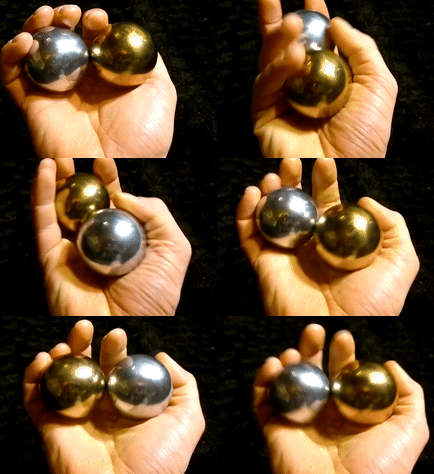 If you’re not familiar with “dexterity balls” (also called “baoding balls”), they’re those metal balls you rotate in your hand.
Here’s why they work so well…
As your fingers are working independently to rotate the balls, you’re literally reprogramming your nervous system to separate your trigger finger from the rest of your grip.
That means your hand can stay in “crush mode” for recoil control…
…while your trigger finger stays loose and fast — just like you need it to.
Now, I will say that I have some issues with the traditional metal balls…
They’re slippery and tough to get “finger traction” on.
They’re tough to rotate because they slide all over your palm.
And they’re pretty unforgiving if you happen to drop them on anything hard.
(I may or may not have broken a tile in my kitchen when one popped loose. )
So I actually invented my own patent-pending version of dexterity balls.
 I call them “Tacti-Balls”.
Same core concept and same size and weight — but coated in a grippy layer of safe, tactile silicone.
This makes them:
- Way easier to control.
- Way easier to rotate with your fingers.
- Way easier for beginners to master their movement.
- And honestly… way more effective for shooting-specific training.
Plus, I designed them so that the weighted steel core is slightly off-set so they better work your hand’s and wrist’s “support muscles”, tendons, and ligaments for even better “crush grip” training at advanced levels.

But whatever you choose, these types of “boading balls” are one of the best-kept secrets of master shooters like Navy SEAL, Chris Sajnog, Mike “Ox” Oschner, and the late Ron Avery.
All together, these 3 factors I shared will not only make you the most envied shooter at the range – but, defensively, you’ll have much higher odds of stopping a determined attacker as fast as possible with accurate “rapid-fire” tempo.


Aim small miss small, if I can get away with it I put fired 22LR cases at 50 yards. Instead of cans. With life like targets buttons on the shirt should be the same principle.
What are you shooting the 22LR cases with Sam? A .22 rifle? Besides “Aim small, miss small” (I actually prefer “Aim small, hit small” ), what other accuracy tips have you uncovered?
I always enjoy learning from the wisdom your comments bring to our blog posts so I thought I’d ask if you have any gear or technique tips for your 50 yard micro-targeting.