

It’s a matter of life and death…
Too many people think carrying a firearm is all they need to do to protect themselves and their families against any and all danger… but this is simply not true!
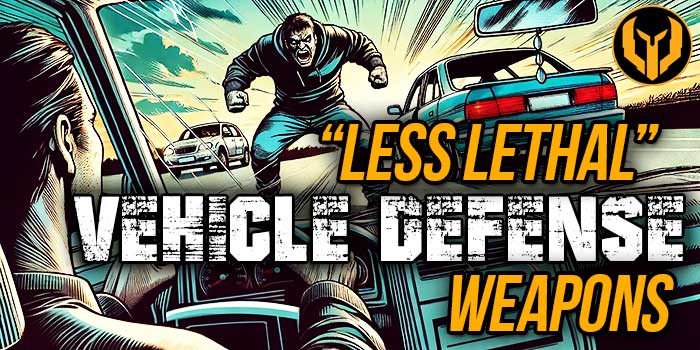
Picture it… you’re pumping gas in your car when, before you can react, you have an attacker on top of you… and you can’t get to your gun.
You’re going to need to fight to it.
Your fists might be able to get the job done… but wouldn’t you like something a little more effective?
That’s why I carry a knife every day in addition to a firearm… as a backup weapon in case I have to fight to my gun – but…
When It Comes To Real-World Self-Defense Scenarios, Not All Tactical “Combat Knives” Are Created Equally!
Here Are 4 Life Or Death Factors In Everyday Carry Knives For Self-Defense…

There’s just about as many “tactical” knives on the market as there are customers for them.
With so many options it can be hard to know what you’re even looking for… what separates a “good” knife from a “bad” knife.
It’s not about the brand or how “cool” a knife looks… there are four essential factors to consider… and they can make all the difference between life and death in a real-life street fight.
Life Or Death Factor #1: The Grip
It can happen to anyone and without warning…
There’s a man on top of you, beating on you… you can’t reach your gun, but you can reach your knife.
That’s great, but…
…you’re still going to have problems if you haven’t purchased the right knife.
Why?
When your adrenaline is up, one of the first things to go is your fine motor skills... that means you’re going to be extremely clumsy.
Not only will you be clumsy, you will also have sweaty palms, compounding your physiological problem with one of pure physics:
Sweat is slippery… and so is blood.
At some point during this fight, someone’s blood — yours or his — is probably going to end up on the knife, making it even harder to grip.
If you can’t hold the knife, you can’t fight with it.
So what do you want in a knife to make sure you can actually hold it during the fight?
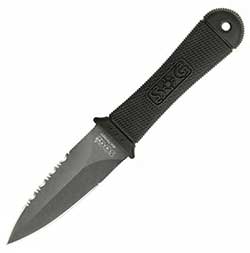
- A rubberized or G10, no-slip grip to ensure you can keep your hands on the knife at all times.
- An ambidextrous grip so that you can pick up the knife with either hand in the event you drop it – and the blade’s still in the right direction. (More on this in a minute…)
- Avoid at all costs blades with crosscut steel grips, 550 cord grips or any other nylon-based grips.
Life Or Death Factor #2: The Blade
It’s arguably the critical factor in choosing a knife…
Presumably, your attacker isn’t going to be naked when he attacks you… if he is, you’ve got way bigger problems.
In fact, there’s no telling what he could be wearing… and he’s wearing a t-shirt, a leather jacket or a full suit of armor… the basic problem is the same:
Your blade has to cut through whatever your attacker is wearing to even get to him.
Now not all blades are created equally and this is definitely true when it comes to penetrating through clothing to make it to your attacker with the business end of your knife.
There are other factors in play with the blade than just cutting ability… remember what I said above about “what if you drop the blade?”
Look, obviously if you’re right handed you don’t want to be wielding your blade with your left hand and vice versa… that would definitely be less than optimal.
Way worse than that, however, is not being able to wield the blade at all... that’s why you want an ambidextrous grip… but even that’s not enough to make you a serious threat with both hands using your knife.
So what should you look for when it comes to a blade?
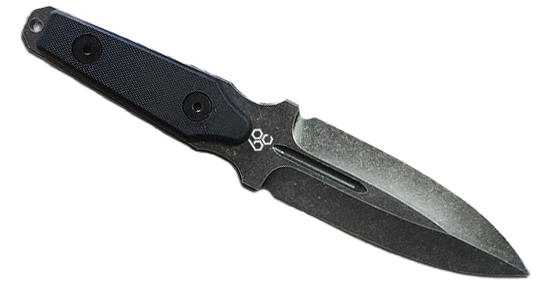
- Double-edged blades are the “stabby part’s” version of an ambidextrous grip, making it easier to attack with whatever hand you can reach the blade with.
- Serrated edge blades are sharper and can cut through materials from t-shirts to leather jackets much easier… no guarantees on that suit of armor, though.
- Quality steel is an absolute must with 440 series stainless steel being the absolute minimum.
Still, there’s one more critical factor that can make all the difference between life and death…
Life Or Death Factor #3: The Draw
We’re going to come “full circle” here…
Remember why you’re using your knife in the first place?
Because you can’t get to your gun.
Just like your gun, a knife is useless if you can’t actually draw it, open it and commence to stabbing away… and the faster and easier you can do this the better.
You’ll also have to balance your need for quick draw and deployment with local laws and our general rule that says “be tactical, don’t look tactical.”
Now if you’re a combat soldier, nothing beats a fixed-blade knife kept right on your belt.
The rest of us though are going to get some serious looks walking around Walmart with a ka-bar hanging off of our jeans.
For civilian every day carry there’s no real serious alternative to the combat folder.
You can carry it right in your front or back pocket allowing you to deploy it when you have to and look like “every other guy with a pocket knife” while you walk around the mall.
Beyond that, all you really need to look for is something that opens quickly… the quicker the better, honestly… just be sure it conforms with state and local laws.
Life Or Death Factor #4: Versatility In The Fight
Just like any fight, the dynamics of who and what you’re defending against is a dynamic situation…
You could be flat on the ground… on your stomach… or back…
You could be facing multiple attackers in an instant…
Your attacker may even suddenly pull out a gun..
The more options your knife gives you to react to these changing dynamics, the better.
That’s why “single position” knives (like the ultra-curved blade on a Karambit) are poor choices for a self-defense weapon.
But there’s one other factor I look for in my knives…
… throwing ability!
Yeah, yeah, I know…
“Never throw your weapon.”, right?
Most of the time, it’s a good rule… but like most good rules, it has a lot of exceptions.
For example, if an attacker is going for your loved ones and you can deploy your knife faster than your gun… which would you choose… especially when seconds can make all the difference between you giving the police a report and you visiting your loved ones in the hospital… or the morgue.
Another reason you might want to throw a knife is to create a distraction or to strike first while you retrieve your primary weapon, good old Mr. 9mm.
But knife-throwing is a skill… and like most skills, it’s better to “have it and not need it” than to “need it and not have it.”
Now if you’ve ever seen knives thrown on movies or television or even done it yourself in your buddy’s backyard, you’re probably thinking of a knife being thrown one specific way… end over end, twirling in the air.
It might look cool on the screen and it might work against immobile, wooden targets not actively trying to kill you or a family member… but it’s the absolute wrong way to throw a knife in combat.
Why?
Because you have to gauge the distance between you and the attacker, then time your throw so that the correct end of the knife — you know, the pointy part — makes contact and not the end you were just holding onto.
Good luck doing that against a moving target.
Fortunately, there’s a better way…
You see, Ralph Thorn is a bit of a genius when it comes to throwing knives… he can do it while he’s on the move, behind his back and even at weird angles and awkward positions.
His secret is his development of his “no-spin” knife-throwing technique for use in real combat and self-defense scenarios.
Now I know what you’re thinking… knife-throwing is something for seasoned Special Forces operatives… the real life “John Wicks” of the world who could kill a man with a pair of rusty tweezers or old chewing gum if they had to.
Nope.
The truth is, anyone can master knife-throwing using Ralph’s “no-spin” technique – and it actually becomes second-nature with just a few short hours of practice.
And the best part yet…
…once you learn how to throw a knife properly basically anything pointy that can be thrown becomes a weapon.
Those little scissors you use to cut fishing line?
That’s a weapon.
The rusty old screwdriver in your garage you’ve been using as a chisel when you can’t be bothered to look for the real thing?
Also a weapon.
The same chisel you miraculously find at the same time a man breaks into your garage?
Yep.
A salad fork?
(I think you’re getting the point here.)

I have some of his material. And there is an amazing guy on YouTube I watch who can throw anything using every method, but even that guy and others use Ralph’s techniques.
I’d like to comment that when you throw a knife, the point is not to “throw it away”, but to turn it from a melee weapon to one that can cover a distance faster than one can run it. I’m tired of some smart ass saying, “Now you’ve thrown your only weapon away”. Why assume that anyone has only one knife or one weapon. I am sure knife throwers can am themselves with several throwing implements and other weapons.
If someone is about to draw a pistol or other weapon or to do something that can harm someone else such as cutting their throat or cutting a rope and letting them fall or pressing a big red button that launches a missile, and you can’t reach them in time then you can stop them with your knife, axe, or improvised weapon.
In the appropriate situation, knife throwing is a useful skill.
Poking around somewhere in all the Warrior Life training material, I remember seeing a video segment featuring Ground Fighting instructor Damian Ross. He starts the segment wearing a normal t-shirt and jeans – nothing looks at all out of everyday ordinary. Damian then proceeds to unload onto a table he’s standing next to, an assortment of edged weapons (incredible in both numbers and types). His point (and the one you amplify) is to never assume that a threat has only one edged weapon at their disposal. Tongue in cheek aside to your point, but all the smart asses I know would comment that they’d never let me in a room with the big red button in the first place – LOL! I’m pretty sure you’ve given this due consideration and are better informed on the subject than most simply because you can correctly use the phrase “melee weapon” in a proper sentence. I agree with your conclusion that having the skill to predictably throw and “stick” an edged weapon can be useful. The kid in me compels me to add that it can also be something done just for recreational fun. From time to time, Jeff offers deals on sets of throwing knives that won’t break (knives or the bank) when people are still learning the skill. You don’t mention it in your first comment, but have you tried that set? (sorry, but at the moment I can’t recall the product name used for those knives – perhaps someone will tag in with that info and offer up their own knife throwing experiences as well).
Not keen on the idea of throwing knives at an attacker. Simple reason is that they might just pull it out – and then use it on you. Getting an instant or quick stop with a handgun is not guaranteed, and even a stab or slash wound that causes rapid blood loss may take a while to incapacitate.
I prefer a fixed blade at least five inches long. Current carry is a Cold Steel Kobun serrated, and sometimes a double edged Polish dagger with a blade almost 7 inches long. I do sometimes carry a Cold Steel Pro Lite serrated folder. All street legal in Texas, and I care that it might upset some people on the street or in the supermarket. I also carry a 3″ utility folder so my defensive/emergency blade is always very very sharp.
In a contact hands on fight a good size knife can be better than a pistol. And the bigger the better. For one thing it is very difficult for someone to take a very sharp knife from you, and if you have a second blade accessible, you can go to work on them while they are focused on the first one. A pistol or revolver can be disabled and perhaps wrested from your grasp. All they have to do is grab your pistol and stop the slide from cycling – you’ll have one shot. They may be a lot stronger than you and able to turn the muzzle away or even direct it at you. They may induce it to fire by pressing your trigger finger. Even a person with modest hand strength can disable a revolver instantly by grabbing it around the frame and cylinder. Unless the hammer is cocked at that point it will not fire because there is not enough leverage in a revolver trigger mechanism to cycle double action if someone has a tight grip around the cylinder
Knives greatly reduce the need to be concerned about causing injury or death to any innocent third party. You just go at it fast and furious, it is very intuitive – eyes, ears, throat, armpits, up under the sternum, lower back/kidneys on down to the groin and inner thighs. Stab, rip, repeat. And/or slash. There’s more but that is a good start.
So a pistol or revolver, and two knives, is the way to go in my opinion. The laws vary from State to State – just carry the largest blade possible. And I would encourage people – where legal – to carry fixed blades. They are faster to deploy, almost fumble proof, and stronger than comparable folders.
What knives will do all these criteria and not break the bank. Also not be illegal or impossible to find in Canada. I found a Swiss knife company on Amazon. It is the Morakniv companion. It fits the criteria but it’s not serrated.
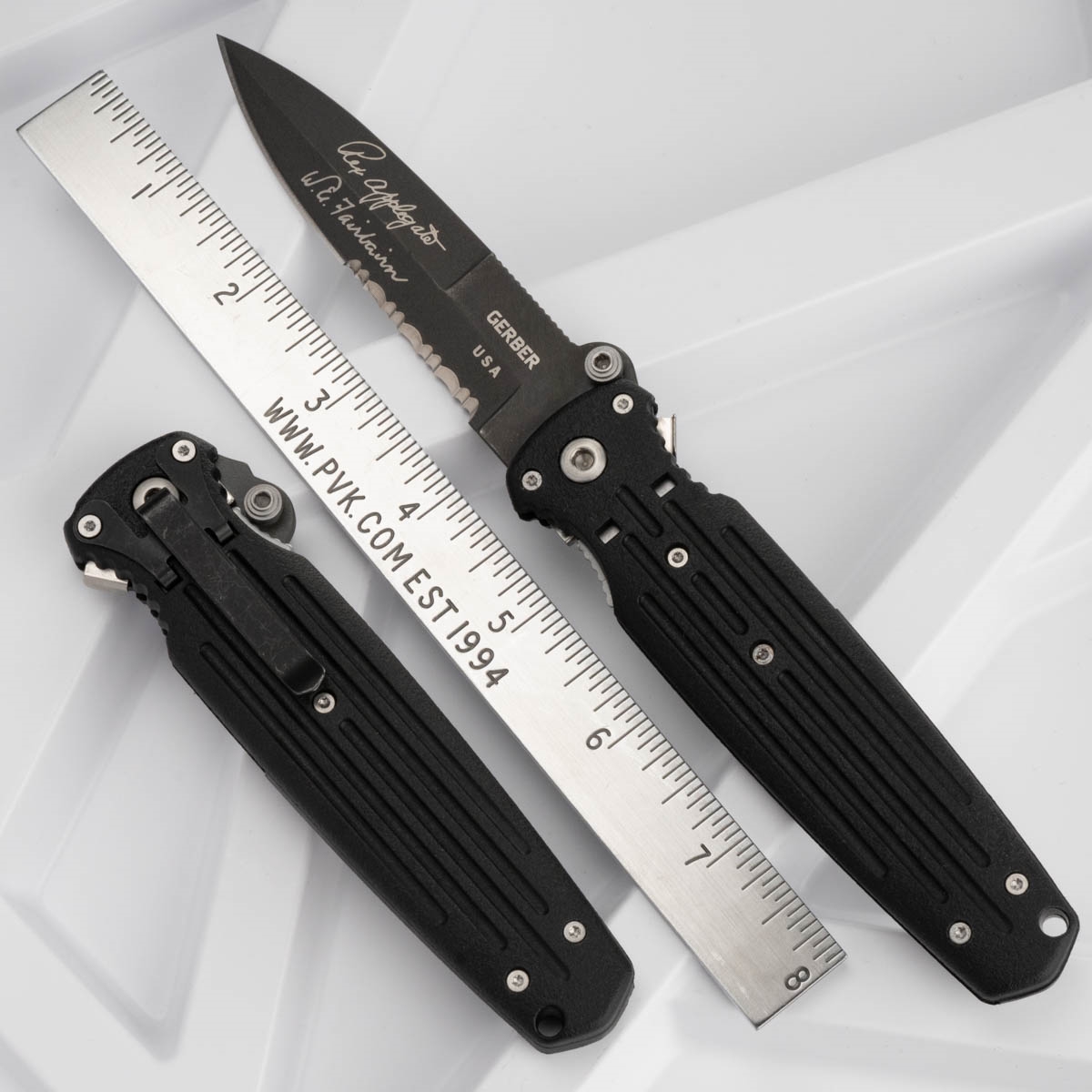
The Gerber Applegate Combat Folder is a one-handed opening (ambidextrous) sturdy folding knife with a 4-½ inch double bevel, partially serrated blade. The top bevel is not sharpened, but could be if your state allows double-edged knives to be carried.
The “Emerson Wave”, so it deploys the folder on the way out of the pocket. Have one on a Kershaw Tanto that makes quick work of Amazon boxes on recycle day…
…officer.
Can u recommend a good knife to have on you and able to throw please?! My carry knife failed 3 of the 4!!
Just an edit to my first post…
I prefer a fixed blade at least five inches long. Current carry is a Cold Steel Kobun serrated, and sometimes a double edged Polish dagger with a blade almost 7 inches long. I do sometimes carry a Cold Steel Pro Lite serrated folder. All street legal in Texas, and I do not care that it might upset some people on the street or in the supermarket. I also carry a 3″ utility folder so my defensive/emergency blade is always very very sharp.