

If you’re a “knife guy or girl“, then I’m sure you’ve heard of the famous “Kukri“, right?
Actually large enough to be classified as a “machete“, the Kukri has become one of the most popular blades on the market today.
It’s understandable, “why”…
For more than 500 years, the fearsome Gurkha warriors of Nepal have fought for multiple military units around the world in some of the most brutal close-quarter battles.
In fact, when the mighty British Empire invaded Nepal in 1815, they were easily beaten back by the Gurkhas.
The Gurkha’s primary weapon was… the Kukri machete!
Now because of the “image” the Kukri has thanks to its association with fierce Gurkha warriors tons of people say it’s the “ultimate” fighting machete… but I’m not convinced – and here’s why…
Is The Kukri Machete REALLY The Best Design For Edged-Weapon Fighting?
The Best Survival Machete For Real-World Combat Demands Specific Functions. Let’s Put The Kukri To The Test…

To be fair… it’s not just the “image” that makes the Kukri so popular…
One of the reasons the Kukri is so popular is that people think the Kukri’s angled blade has certain design advantages.
Unfortunately (in my humble opinion – after hardcore “pressure testing”), a lot of these features actually work AGAINST you in combat.
Let me tell you why…
Problem #1:
The Kurki Machete Is Good For Chopping…
But Terrible For “Stabbing”
The Kukri’s blade, by design, is angled DOWN.
This puts the weight of the blade forward, making the Kukri a good “chopper” by focusing the energy of a downward blow into a more vertical direction.
This works great if you’re hacking a log or branches below waist level (where the vertical movement is best harnessed)…
…but in a real-life fight, the enemy is moving and your primary targets are above the waist.
What’s more, angled attacks are the easiest to deflect, which is why one of the most effective tactics is a “thrust” attack.
This is one of the most effective techniques with a large blade, and a real “fight-ender“.
With the Kukri’s knife tip and blade angled downward, stabbing is much more difficult because it doesn’t support a natural thrusting movement.
Problem #2:
The Kukri Machete Is Easily “Snagged” In Edged-Weapon Combat
That severe downward curve of the Kukri has another disadvantage beyond stabbing…
…it snags… badly!
The angled blade means an unnatural “hooking” of whatever it strikes, as it transfers the power of the blow into the target.
That means that the blade can easily become lodged in bone if you chop at an attacker with it.
Now, having a big knife lodged in the bone of an arm or leg is going to ruin ANY “bad guy’s day.
But it also means you’ve gotta un-stick the blade to use it again… and that’s tough to do with the angle of the blade.
A better choice is a blade less likely to hang up in the target, or to snag on things around it.
A straighter blade shape is much better for close combat conditions like that.
Problem #3:
The Kukri Machete Can’t Be Thrown Easily
Now, I realize that throwing ANY blade is pretty controversial in a fighting scenario.
I mean, why would you ever “throw away” your primary weapon, right?
Well, I don’t (fully) disagree.
The fact is, though, there ARE times where throwing a knife (or yes, even a machete!) can give you a distance advantage that your attacker doesn’t have – either as a distraction for a follow-up attack, or as a true “tactical move”.
The Kukri is extremely awkward for throwing due to its angled design, and it’s very likely you’ll hit your target with the back of the blade where it bends downward.
That’s just physics.
Straighter blade profiles are far more easily thrown.
(More on that in a minute…)
Problem #4:
Blade-To-Blade, The Kukri Machete Has No “Flow”
One of the most important things about fighting with a blade is that it must “flow.”
You’ve got to be able to keep it moving, striking THROUGH your enemy and, if necessary, through and past his own blade.
Striking blade-to-blade with the Kukri SUCKS because the angled blade shape naturally catches on your attacker’s weapon.
We found this out the hard way when developing our “Combat Machete“ fighting system.
Testing out multiple types of machetes, the Kukri performed the WORST when it came to blade-to-blade fighting, and we found that, upon contact with another blade, disrupts your body’s natural balance upon contact (at best)… and can even actually direct your attacker’s blade into you (at worst)!
When you look at these design flaws, you can see why the Gurkhas had to train so extensively to take advantage of the features, while avoiding the blade’s challenges.
Chances are, you’re not training thousands of hours in a Gurkha regiment, right?
That’s why we chose the “Bolo” blade when designing our Guardian “urban survival” machete…
The Bolo Machete: The Best Survival Machete For Fighting… EVER!
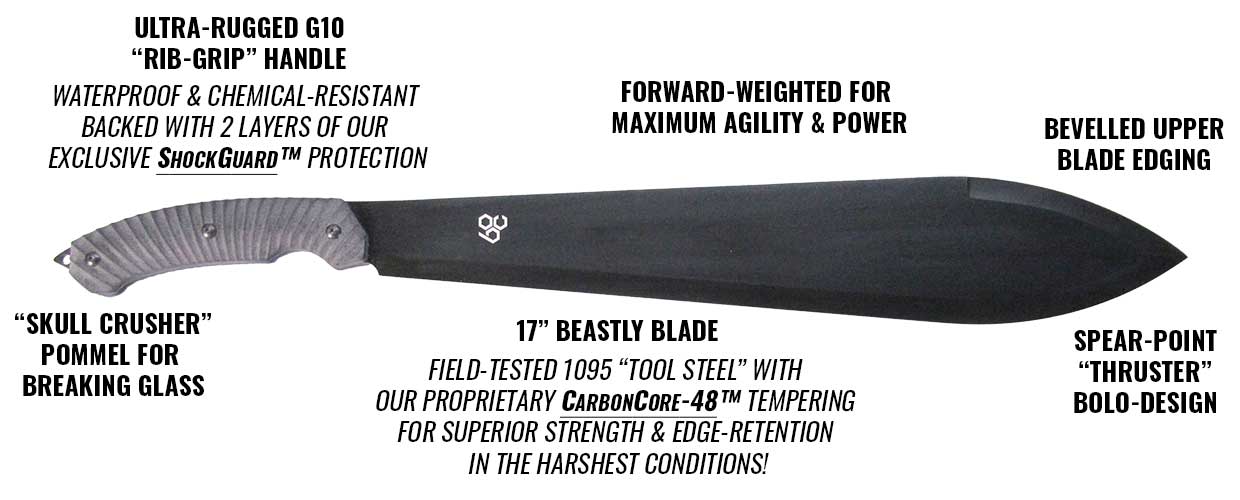
Not as well-known as the Kukri, the Bolo design out-performs it on all of these points…
First, because of its symmetrical “sword-like” shape, you can thrust easily with the bolo.
Second, the bolo machete won’t get snagged, even thought its blade shape and forward-weighted design still makes it an excellent chopper.
Third, the bolo machete is can be thrown very easily if the situation calls for it.
Note: Here’s a video of me throwing a “bolo” machete from about 40′ away…

Finally, the bolo flows in combat just like a sword… because that’s basically what it is!
Its symmetrical design and straight spine keep it passing through your target with a flow that makes follow-up attacks a natural extension of your body’s movement – giving you more options for angles AND setting you up to better defeat multiple attackers with your machete.
I think you’ll agree that the Bolo is one hell of a combat blade, right?
In fact, it just might be the best choice for survival and for edged weapon fighting… no matter what kind of emergency you face.


Oh, and my other knives. I have A LOT. Victorinox (Soldier, Trekker, Forester), Kershaw, Cold Steel folders, and various fixed blades like the Ontario Navy Mk3 (improved stronger tip), Polish military WZ.98 7″ knife and dagger, Cold Steel Kobun Tantos to name a few. And speaking of Cold Steel, the Recon Tantos and SRK are both excellent value for the money.
My choice is the Tramontina 12″ machete. The blade is carbon steel with a spring temper so it won’t take a set of subject to bending forces. They are cheap and easy to sharpen, will chop as well as a small axe, split wood aka “baton”, and can be used as a large knife – or weapon.
Paired with a Morakniv Bushcraft and a thinner blade Companion 4″ knife for general camp cutting chores. These are lightweight and have extremely ergonomic and grippy handles. Moras are cheap but have high quality Swedish steel blades both carbon and stainless with the easy to sharpen Scandinavian grind single bevel. Best bang for the buck in the knife world.
You can buy more expensive and arguably better machetes and knives, but these are $15-$20 each and do the job extremely well.
Heavy: multiple styles of machete, tomahawks, modified axes
Medium: multiple K-bar and similar large fixed blades, lightweight tomahawks, modified hatchets, flat throwers
Lightweight: fixed blade less than 6 inch overall, push dagger, various switchblades, multi-tools, folding knives etc. Criteria is less hard and fast rule than suitability for intended purpose-but every tool has to prove itself in use before being added to the armory.
I have a kukri, throwing knives, throwing tomahawks, regular tomahawks, fighting sticks, hardened aluminum cane with multiple sections that have different weapons, mini crossbow, sling shot, 9 mm and other objects to get the job done. I have your ultimate machete where you were cutting a car hood in two with it although I can’t think of the name of it right now. (Sorry) I have two swords but they need to be sharpened for actual combat. They’re display swords but I can’t find anyone that can put a proper edge on them. I want to get a spear and a regular crossbow but I need to get one that a 71 yr. old woman can handle with relative ease, (if that’s possible, lol).I have as I said, a 9mm Ruger LCP but would like to get some other balistic weapons like an AR-15 for home defense but just can’t afford them. I really prefer quiet weapons but they are more up close and personal weapons which is sorta disadvantage for someone of my age because I’m a female and 71.
This article is very flawed. It makes the assumption there is only one type of strike possible with a khukuri. There are different parts of the khukuri edge used for different purposes and different strikes from a martial perspective. The khukuri “sweet spot”, inside the curve, is not always used. Cuts can be made with the outer portion of the blade where it wouldn’t stick in the target or possibly hook the target.
The angle and severity of the blow can also be controlled by the fighter. There are quick snap cuts, slower, dragging cuts. Powerful chops. Plenty of stabbing techniques, many times using the unarmed hand as a support and guide on the back of the spine. One could argue the hand is actually at a stronger and more natural position for a strong stab than a traditional, Western style straight sword or bowie. Being a different angle doesn’t mean it’s worse. Just different.
The khukuri isn’t always held solidly in the hand. The grip tends to be more loose, much like when swinging a machete. Allowing the khukuri to have more movement and freedom in the swing. This allows more control and precision in a specific cut to achieve a specific attack.
The article also assumes there’s only one type and style of khukuri blade. There are many different styles and angles used throughout history. Many historical khukuri examples designed for fighting and combat have a much more shallow and less severe cutting angle than those you might see used more for utilitarian purposes like chopping wood. Khukuris come in many different blade lengths, spine thicknesses, and styles.
I wouldn’t discount the khukuri as an effective fighting blade until one trains and studies specifically in khukuri fighting and Nepalese martial arts. In my opinion, I believe the khukuri to actually be a superior fighting blade to something like a Western bowie. It just comes down to training and experience.
Surely, to each his own when it comes to selecting a “fighting machete”. Our tests with the Khukuri are revealed in the article and really lacked the flow needed for staying mobile and going blade-to-blade. This is due to both the angled design of the typical khukuri and how it makes contact with something other than the intended target (like another blade), as well as the brain’s awareness of where the tip and edge of the khukuri are at any time during movement (aka “proprioception”). Now, of course, why would the Nepalese stick so strongly to the machete if it didn’t perform well in combat, right? It has, and yes, there are systems that can train in how to use the weapon, given its design. I’ve had a khukuri hand-forged in Nepal based on their traditional design for testing and review. I’ve not seen a big difference in fighting styles though with a longer blade. It sounds like, with your comparison you mention with the Bowie, you’re referring to a shorter khukuri, which would definitely be a different animal in fighting style when compared with a longer, heavier machete blade. In any case, as I said, to each their own and the most important factor is going to be the training behind the weapon, right? It sounds like you’ve found a system that let’s you work with your blade’s design and that will almost always trump the “tool” itself, so keep up the good work!
Well until you pointed out the design flaws of the kukri, I really never gave it any thought. Of course I haven’t had to try in out in battle but I believe I’ll stick with the one I bought from you some time ago. Thanks for your ever present and relevant advice.
I have two of the Kukri blades in my home for home defense. Problem is that I don’t see where they are in my home. They were kept safe, but now I can’t find them.
That would be a tragedy when a home invader were to kick down my door at 3 a.m., and I wouldn’t be able to defend myself like the recent video of the home invasion, when they home owner used a chair to use as a weapon to defend against multiple attacks in his home.
I have two Guardians.
I also have two Barongs a short a long.
Good to see you back in the comments Sam! Wondering where one of my favorite commenters had gone! Hope you’re doing well Warrior! 🙂
I’m still out here. In the final stages of completing a bicycle towed trailer. Dog version, so my companion and I can visit the country. I am also rebuilding a mountain bike from the frame to make it easier for me to peddle. My arthritic toes don’t bother me when I’m riding a bicycle, which is now my main form of exercise since walking and running hurts my toes. More trailer projects as materials can be acquired.
2 x Gerber knives, 1 Mark II fighting knife, 1 x small knife with spear point; 2 x Kukri fighting knives, 1 Indian, 1 American; 2 x Buck Ranger folding knives; 1 x Woodsman’s Pal; 2 x machetes; 3 x fighting hatchets, 2 modern, 1 18th century design; 3 x Claymore full-size Scottish swords; 1 x basket-hilt Scottish sword
I don’t think you have enough edged weapons. 😀
Hmmm… maybe one more? 🙂
And your point is?…
Wanna sell something? Then provide a link.
And by the way, my choice blade is a Swiss bayonet. I also have a Samurai sword, but that’s a little hard to carry on public. I also carry a tomahawk in my backpack and a laser in my paints pocket which can blind anybody from 100 feet.
But I’m always open to new suggestions.
We’re not just out to make a buck, Alibaba. I hope the information proved useful without something to buy. As for blade choices, one good machete can take the place of both the bayonet and the hawk to lighten the load. Good to see you have backups.