

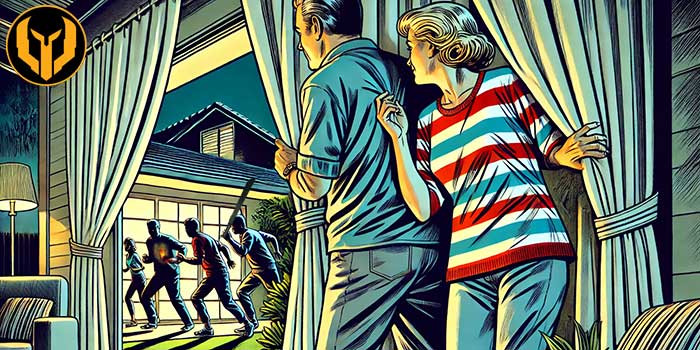
You’re sitting in your living room with your spouse, the tension in the air as thick as the darkness outside.
The power’s been on and off for days, the streets are eerily silent, and you both know that the situation outside is growing more desperate by the hour.
Food’s running low… people are getting anxious, scared… and dangerous!
Suddenly, your spouse grabs your arm and whispers…
“Did you hear that?”
You both move quietly to the window, peering out into the night.
Your heart pounds in your chest as you see shadows moving quickly along the edge of your property.
As they creep closer, it looks like some of them may be armed.
More Than Just A “Nightmare Scenario”, Defending Your Family & Property Is A Reality When Resources Are Low And Local Citizens Are Pushed To Their Limits!
Here’s How To Fortify Your Property Against Gangs, Looters, And Desperate Beggars During A Collapse And Civil Unrest…
Let me ask you…
… Do you feel that your home truly “secure”?
Most likely, you do feel safe and secure in your home – and probably have solid doors and windows, an alarm system, and maybe even a firearm as “backup”.
But during times when a crisis limits the resupply of the resources citizens need just to live day-by-day, your current security measures may not be enough.
When Things Get Tough, Your Safety Isn’t Something You Can Just Leave Up To Chance!
Let’s Dive Into What It REALLY Takes To Transform Your Property Into A Virtual “Fortress” That Can Withstand Whatever Threats Come Your Way…
First things first…
… you need to figure out exactly where your home is the most vulnerable.
Start by drawing a simple map of your property.
Include everything—your house, garage, sheds, trees, and even the bushes – and then map out (from memory at first) the nearest structures and/or terrain of your neighborhood.
This map is going to be your go-to tool for spotting potential problems, and laying out and prioritizing your solutions.
Once you have your property mapped out, it’s time to start documenting your findings.
It’s easy to overlook weak spots when you’re familiar with your property, but that’s exactly why you need to take a step back and…
Look At Your Property With 3 SETS Of “Fresh Eyes”: Your “Warrior-Ready” Eyes; The Eyes Of A Predator; And ONE MORE…
Your View From Above: The Aerial Advantage & Breaching Paths You Probably Never Knew Existed…
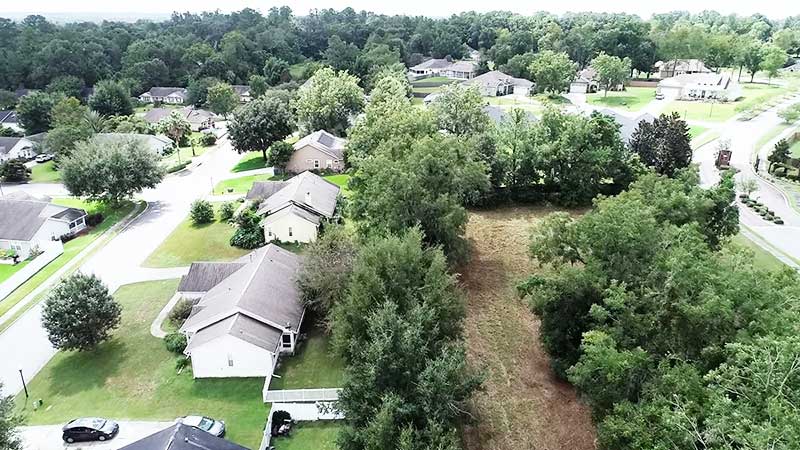
I realize that not everyone has access to a camera-equipped drone, but it’s a powerful tool for your security assessment if you can get to one.
Getting a bird’s-eye view of your property can reveal hidden paths and obscure approaches that aren’t visible from the ground, like:
- “Invisibility Zones”: Areas where thick vegetation or man-made structures can provide cover and concealment for predators.
- Property Layout: Notice how natural pathways – like streams or ridges – could guide or deter movement towards your home.
- Ingress/Egress Routes: For intruders to gain fast-access to your property… and also fast escape routes if you’re forced to escape.
Most people are amazed at the things they’ve never even noticed about their property and neighborhood the first time they get an aerial view of areas that they’ve lived in, perhaps even for decades.
But now let’s take a different approach…
It May Be A Challenge For You To Tap Into A “Predatory” Mind-Set, But It’s Absolutely Critical That You…
…”Flip The Script” On Your Home’s Hardening By Looking The Through The Eyes Of An Invader!
We’re all used to looking at our own homes and properties through a lens of “solid security”.
But as local victims of a crisis start watching their families starve when resupply of basic goods has come to a screeching halt, they’ll “see” your property differently than you normally would.
Like a hungry mouse that somehow finds a wee little hole that gains them access to your “cheese”, the desperate can become deviously crafty in how they stop the pangs of hunger in their bellies.
To keep them out, you have to “flip the script” and put yourself in the shoes of someone casing your property for a raid.
What are the vulnerabilities you didn’t spot before?
Look for:
- Cover Opportunities: Are there hedges, walls, or even utility boxes where someone could hide?
- Defensive Gaps: Is your property lined with a high fence that can make it easy for intruders to approach unseen?
- Breaching “Tools”: Are there trees close to your home that can give access to a 2nd floor window? Do you regularly leave a ladder next to your garage that could be used to get to a balcony with a sliding door?
The list of vulnerabilities can get pretty long once you start looking for ways to break your own security plan.
Fight the urge to justify how secure you are and instead try to poke holes in your plan.
Add your findings to your property diagram for follow-up.
From “Predator” To “Defender”, It’s Time To Shift Your Thinking To The Attack That “WILL” Happen, And…
Here’s Your “Inside-Out” Defensive Game Plan For Detecting (And Engaging) A Coordinated Raid On Your Property…
For your security assessment to be useful, you have to avoid the “cognitively dissonant” voice in your head that wants to tell you “this will probably never happen”.
Most likely you’re right – but what if you’re wrong?
Now that you’ve looked through the eyes of someone who will do all they can to prove you wrong, you need to visualize an attack actually happening in order to find weak spots as the “protector” inside your home.
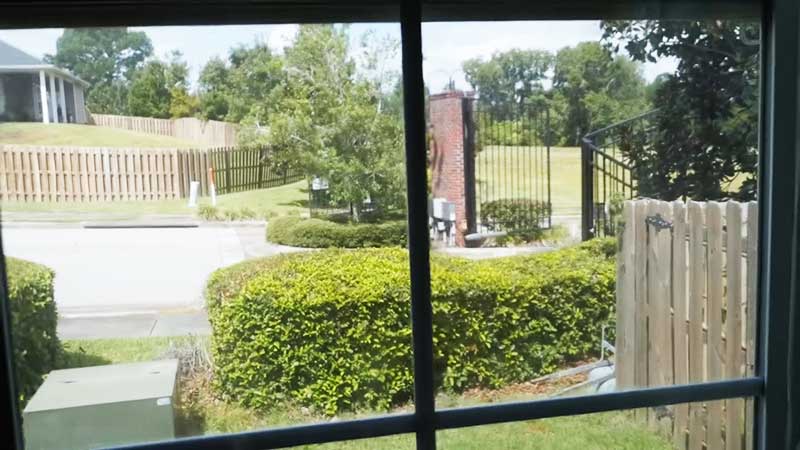
From within your home, look out from each of your doors and windows and ask:
- What do you see? Are there nearby areas where threats could ambush you unnoticed?
- What’s in your immediate surroundings? Ensure that areas right outside your windows and doors are clear of high bushes or structures that could hide an intruder.
- What’s hidden from view? Maybe a fence or bush blocks your sightline to the street or driveway?
- What’s beyond your borders? Identify how far you can see down the street or across neighboring fields. Are there areas where someone could observe your home unnoticed?
Understanding these perspectives helps tailor your defenses to cover these blind spots.
Again, record your findings on your diagram.
Once You’ve Completed Your “3-Eyed Assessment”, You’re Ready To Pull All Your Intel Together To…
Map Your Property’s “Battlefield” Like A Combat Soldier (And Watch The Real Magic Happen!)
In the military, getting “eyes” on your enemy as quickly as possible can mean the difference between a long-distance engagement that fends off an invading force… and suddenly looking up to find they’re already inside your compound.
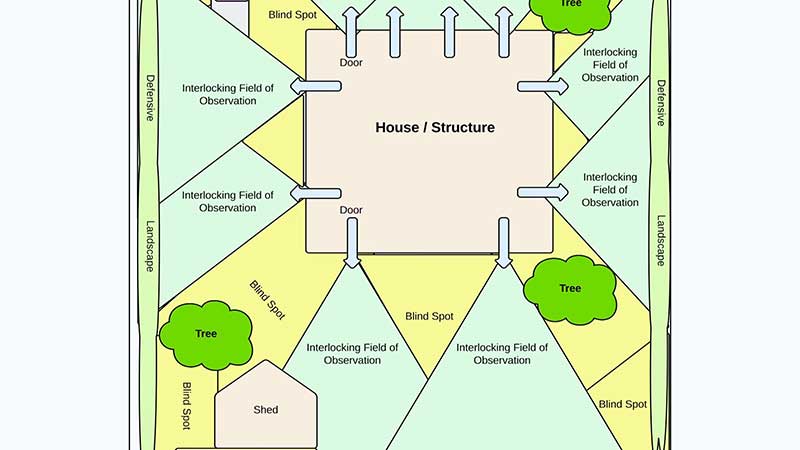
To properly prepare a defensive position, we map out our fields of observation/fields of fire.
This not only helps identify areas that are the most vulnerable and where the “enemy” is shielded from a counterattack, but also helps to identify the best spots for observation before, and during an invasion.
From each of the windows and exterior doors where you can see out of your home, hold your arms out in front of you in a pie-like “V” shape.
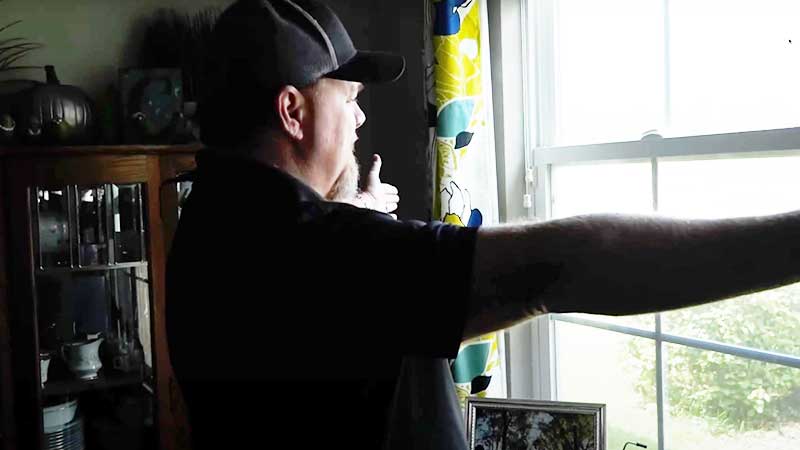
Look to the left and right to identify the furthest most edges of visibility in this “sector”.
Also look for any obstacles that are inside of that zone and notice what could be used as cover and concealment.
Within this pie-shaped sector, you’ll also be able to identify your ideal field of visibility – meaning, while you may be “able” to see nearly 180 degrees from a window, it may take more effort and shifting around for you to get that wide of a range.
So make sure that you’re position in your home is the most likely spot on the floor you’d be watching – or firing – from.
This will narrow your field perspective and give you a more accurate representation of what you can expect to see – and not see – during a raid.
Map these “range fans” on your diagram, noting your blind spots as well as where your fields of observation overlap one another, and from which location in your home.
But we’re not done yet…
Remember, your goal isn’t to “confirm” your defense plan is top-notch – your goal is to break your plan, just as a predator would try to do.
And for that, we have to apply the most likely scenario you’ll face if you and your family are targeted during a crisis…
The Best Time To Breach Your Property Is When You Least Expect It And Are The Most Vulnerable…
Here’s How To “Own The Night” And Level-Up Your Property Plan For A Covert Raid Under Cover Of Darkness…
Your visibility is always going to be better during the day, and it’s important to begin your assessment process when it’s light outside so you can fully identify your ideal observation ranges, blinds spots, and obstacles.
But things change at night – and that’s when you’re most likely going to encounter an attack as the “enemy” will use the darkness to their advantage and get as close as possible, undetected.
When it’s completely dark outside, go back to the beginning of your assessment and look at your home from the sky with a drone if you can.
Look to see what areas of your property are the darkest… and even what homes around your property have more lighting, and less lighting to see how this could determine an invading group’s path to use darkness to their advantage.
Then take the same “outside-in” perspective of the “invader” as you did before and look at your home from far and near.
During the day, it can be difficult to look inside your home and identify people and belongings and not also be exposed to being spotted by people within your home.
But in the dark (as anyone walking their dog at night can attest), it’s very easy to see inside and watch you, realizing that those in the home usually can’t see outside very well.
Finally, from within your home at night, look outside – with your interior lights on and off – to see how this affects your observation and ability to detect predators.
Now here’s a little tip for you that will make a world of difference in your ability to detect invading trespassers…
If you have access to a “night vision device”, consider this a bonus “4th Eye” of your property protection plan.
Not only will they help you overcome the lack of visibility of the darkest areas of your property, but I consider these to be critical gear for home and property defense!
The “enemy” will be using the darkness as cover – and having night-vision capability is the best way to sabotage their plans by taking their advantage of their overconfidence that you won’t be able to spot them at night.
Take a look at the same image of a backyard and what would seem like an “easy stroll” for trespassers under cover of darkness…
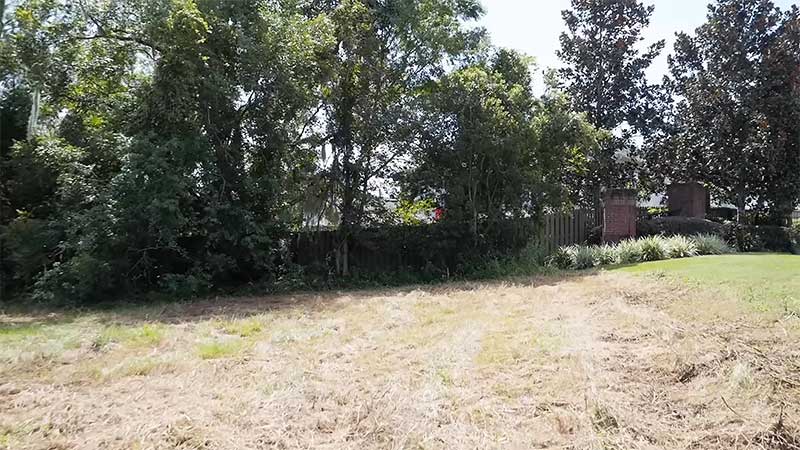
… compared with the advantage night-vision devices can give you for spotting approaching people and vehicles…
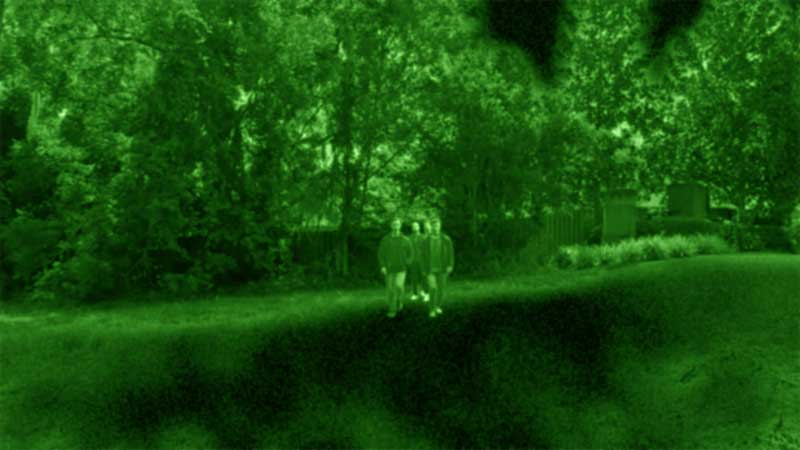
While these handy devices used to cost thousands of dollars to acquire, technology advances have finally put these “military”-type gear additions into the affordability range of the everyday home-defender.
Of course, you still get what you pay for – and for things like rifle scopes and NVG’s (night-vision goggles) I would suggest going toward the higher-end devices – but for property observation and the purposes we’re talking about here, you can find a pair quite inexpensively that will greatly increase the effectiveness of your property protection plan and are well worth the investment.

The Final Step In Your Prepper Property-Defense Plan…
Now that you have all of your intel, it’s time to review your diagram/map and prioritize your fixes.
Look for ways that you can do things like…
- Remove obstacles that are creating blind-spots around your home and property.
- Add “restrictive landscaping”, like thorny bushes, palms, and cacti, near vulnerable windows that could be entry points to your home
- Get blackout curtains that you can close at night to avoid light from exiting (especially when it’s a grid-down blackout and no one else has a generator but you)
- Identify what inexpensive “technology” can be used – like cameras, motion-triggered lighting, night vision devices, binoculars, drones, etc. – to fill in your other gaps
There’s a lot you can do with virtually zero cost and are easy for those of us without the tinkering skills you might think would be required.
But the first step is your assessment… and then get creative with your fixes to keep your home – and most importantly, your family – safe and secure during a crisis.



DHS Certified Home Defense Instr. One of the best and cheapest things you can do to help is Post Signs all around your house that simply say “This Property Protected by Video Surveillance” – Even if you don’t have it. Also be Advised/Caution – if you shoot “Inside” a house with Sheetrock Walls – a 9mm bullet or 223 or Buck Shot, will go thru ALL of your walls(4+) (Think Family in “Back Rooms”, etc) and perhaps outside to your neighbor – unless you have Brick or Concrete Block walls. So – Watch/Know your “Lanes of Fire” – Consider Them – “Now”. Also if your threat is Inside and in front of a window, stray shots may also visit your neighbors. ps 12 ga Buck Shot is “Each Pellet” – essentially the same size as 9mm – so you essentially have 9ea rounds of 9mm spreading out and thru your house with just 1 shot. Effective – BUT – Watch out for family in rooms in the path beyond the threat. DHS Certified Home Defense Instr. I also recommend having a “Gun Mounted Light”(Finger Actuated) on any Home Defense Gun. Gun mounted light- If you have white walls inside you may be able to get enough Light “Splash” off of the walls so you don’t have to aim the gun straight down the hall – say it is a family member in the hallway and not an actual threat – you Don’t want to “Muzzle Them”. “YOUR EARS” – If you shoot just 1 shot of 9mm inside a house you WILL be Deaf for at least 5min – How do I know? 🙂 NOW I keep a set of Electronic Ear-Muffs by my bed – Put on – 1st thing to do.
If anyone comes in the yard from UPS, FEDEX, USPS, etc., my dog tracks their foot steps, I encourage him. Since he is on leash I tell him good dog at the property line. This gives me a heads up for scouts. I can listen to the police and understand when things start happening battery operated lots of batteries. We also go out me armed for potty break after dark so if he starts acting weird I listen to him. Sadly he is getting old 15, so I will be likely looking for another dog soon. There are plenty out there that only need a little bit more time with someone who knows how to get them to work.
With what has been posted concerning private drone regulations , it’s nearly prohibitive to have a drone for simple use.
I agree, a view from above of the surrounding area could be a great benefit but potentially not possible.
Scouting the property extensively would be the next most viable option.
I call it, a full CYA mode since you can trust very little these days.
Stay sharp, pay attention and keep your powder dry.
Yeah, it’s always best to check your local laws and ordinances Old Grandad. Good point.
The way I look at a LOT of preps these days (especially with more regulations restricting “what” we can use and “how” we can use it) is that there’s a “pre-collapse” and a “post-collapse” set of rules.
In other words, what may get you written up for a citation during “normal times” won’t be a consideration (at the time) in the aftermath of an infrastructure collapse – so it’s still good to have items like these on stand-by for when they’re truly needed.
That being said, you have to also be aware that when (if?) things return to normal, you may be held accountable for the actions you take when your local area was reeling from the post-collapse effects.
Thanks for sharing OG!
My local county auditor has airel images of all properties in the county on their website. Perhaps this could be helpful.
Definitely helpful for the bad guys…
On the topic of using an aerial drone to surveil your property, a couple of very important notes. If your neighbors happen to call local law enforcement and they actually show up at your location asking for your drone operator license and registration information, remember that Federal laws under FAA authorization allow them to do so. Unless you have your Part 107 FAA Airman Certificate with a Remote Pilot (UAS) endorsement, your answer to any official inquiry should be “I’m flying for purely recreational purposes.” Admit to nothing else. As crazy as it sounds, you MUST have your Part 107 certification and your aerial drone must be registered with remote ID capabilities installed and active to informally “map” your property, look for potential hazards, inspect your roof – ANYTHING other than “simply flying for recreational purposes”. Even as a purely recreational operator, you should possess a TRUST (The Recreational UAS Safety Test) completion certificate that can be obtained online at no cost and with minimal study/knowledge requirements. I also strongly suggest that you have specialized drone insurance that covers any damage resulting from an unexpected drone failure/crash. While the FAA “owns” and regulates the skies (including that over your own and/or your neighbor’s property), legal aerial drone operation continues to come under ever-increasing legal complexity and pressures as governments struggle to exert their will on citizens at local, state, and Federal levels. Don’t be caught unawares – the fines and penalties can be devastating!
Drones are perfectly legal here in Fl. No license needed unless your making money. If your drone is over a certain weight, it will have to be registered with the FAA, it cost $15 and is good for I believe 7 years. Then you are required to have your “registered number” present on the drone and a flight plan when flying. But only if its over a certain weight. Be mindful all neighbors wont like a drone flying over-head, (one of mine was shot down) and it is a felony to even throw rocks at them, so be respectful of others and have fun while doing some recon….SEMPER FI
Jerry – I’m an FAA certificated airman with a small UAS endorsement (Part 107 drone pilot license), and I’ll respectfully add several corrections and clarifications to your posted comments. If you’re doing anything other than “recreational flying” (for which you’ll need a TRUST certificate anywhere within the U.S.), you’re going to need an FAA issued Part 107 license. As crazy as this sounds, the FAA says you can’t even inspect the roof of your own home without one, because that’s not “flying exclusively for entertainment”. There are now additional requirements under 14CFR Part 89 that requires an approved and activated Remote ID (RID) module device on any drone 0,55lbs/250g or more used for any purpose including recreational flying, and for all drones being operated under Part107 rules regardless of weight. As an additional note of caution, States, counties, cities, and even specific recreational areas can have their own regulations in place regarding small UAS (aerial drone) operations. There is a very small exception carved out for operating drones entirely within Federally Recognized Identification Areas (FRIA) – that are usually operated by recognized clubs using radio controlled model aircraft. As you correctly note, the Federal Government treats drones as aircraft – violations of rules (whether you properly understand them or not) can and has resulted in serious criminal penalties and potentially massive fines. While the FAA doesn’t have the manpower to enforce many of these regulations, local law enforcement (responding to neighbor complaints) can and often do respond to reported violations – handing off verified cases to the FAA. Aerial recons of your home don’t qualify as purely recreational, and the fact that your drone is used exclusively over your own property doesn’t exempt you from Federal regulations regarding drone aircraft. As if all that isn’t bad enough, many legislative locations continue to press for complete prohibition of non-US manufactured drones including all models of DJI and many other brands on the basis of “national security” concerns!
I realize this article is about making assessments and cover and such, but since firearms and drones were both mentioned I have a few points to bring up. First is that one can implement other weapons for self-defense besides firearms and lethal projectiles. Inside our own domicile we can place weapons anywhere we want to, and an intruder would be at a great disadvantage.
Secondly, dogs can be factored into your home and personal defense if you have them. They will bark which at that moment may thwart an intruder’s plans because the dog has alerted everyone inside and then you may peek out the window with lights on or off or with night vision, but I am sure only a few people will even have night vision, so most of us will have to peek through windows which makes me think some kind of mesh would be a good idea rather than allowing ourselves to be seen through uncovered glass. And if a dog or dogs intercepts an intruder, is the terrain, layout, etc., pose an advantage, disadvantage or danger to the dog? I’d want the bad guy or guys to be easy fodder for the dog or dogs so they can be most effective.
It might be important to note potential problems from neighbors that leave certain items accessible that can be used as weapons or to breach your home. Some people leave stuff outside and around the home.
In regard to drones, I was just given one of those tiny drones and it does have a camera. I have not even tried it out yet, but I did not think it required any kind of license. There is a difference between phone cell sized drones, drones for kids and the commercial type that can fly faster and farther and can carry items. I can’t imagine they are ALL treated the same. Or are they?
Interesting article, good comments and an area of prepping and personal security that everyone should put some time into learning.
Hey Frank – you can confirm details beginning at https://www.faa.gov/uas/getting_started U.S. airspace is owned/controlled by the FAA, but that doesn’t mean that your local state/county/city jurisdictions don’t add their own legislative limitations – it’s a complicated system of rules that seemingly defy a great deal of “common sense”. Of most significance is a two part test – A. is it being used for anything other than pure recreational use? If you answer, “I’m taking a photo of my property”, you have moved the flight into the realm of commercial operation that requires a Part 107 Airman certification with a UAS endorsement (no kidding). B. If the operational flying weight of the drone (Unmanned Aerial System or UAS) including all batteries and mounted gear weighs more than 250 grams (8.8 ounces) it must be registered and additionally equipped with Remote Identification Device (RID) technology. Unless this device is flown exclusively within a Federally Recognized Identification Area (think of a government approved/registered airport area for recreational/hobby flyers of model aircraft), operators must possess a current Part 107 Airman’s Certificate. Note the comment that even if you are operating a drone for purely recreational purposes, you must have in your possession a TRUST (The Recreational UAS Safety Test) certificate. With the adoption of Remote Identification (RID) in the U.S. virtually any drone capable of flying outdoors will exceed the under 250g weight limit and will require registration. Even if your drone were under the 250g maximum weight limit, if you’re using it to take pictures of your yard, look at your roof, look for your dog, check to see if your grass needs to be cut (and so on), the government calls it a commercial use and you’re on the hook for the whole registration and certification process. It’s not a fast, easy, or cheap process for most people. Local law enforcement will quite possibly be the first “regulatory enforcement” element you’re likely to come into contact with (especially if you have “concerned” neighbors), and they’re likely to know less about UAS laws and regulations than you’ve garnered reading my reply. Things get even more complicated if you live anywhere in the vicinity of an airport – with vicinity usually translating to a “big aSS patch of real estate”. It costs $170 to sit for the 2-hour long 60 question Part 107 exam after you’ve applied for and received your Federal Tracking Number (used to track U.S. airmen), you can spend months of prep time doing all your own study, or pay somewhere around $150-$200 for a training course. I’d recommend Drone Launch Academy Part 107 Prep for $197 and they’ll give you a guaranteed pay to pass deal. (Even if you pay for a course, it’s not at all an easy exam – it’s virtually the same written test that you’ve got to take to become a Private Pilot flying a Cessna airplane). I took the hard route, taught myself over almost 6 months (lots of time was spent waiting for an authorized Part107 testing center to open up a test session) and passed with a 92 on first attempt. Did I mention that you’ve got to renew your Part107 certificate by testing every two years to be current? At least that’s now free and done online via the FAA. There are also innumerable regulatory efforts afoot to ban almost all foreign made drones from any use within the U.S. (includes the most popular models from DJI, Autel, Potensic, Holystone, and pretty much the entire Amazon.com line up). In summary, the drone skies in the U.S. are neither particularly fun nor friendly. You’re competing for airspace with everybody from your favorite package delivery company to your local Walgreen’s – and they’re continuing to pump big dollars into the system to help keep you grounded.
This isn’t completely accurate regarding drone use. You do not need a license to fly a drone for recreational use (including taking pictures of your own property, for your use as long as it isn’t used to make money). There are some limitations to size and you do have to pass a basic safety class, but the license requirement is different.
Chris – respectfully, you need a TRUST certificate to legally operate any UAS drone for purely recreational purposes anywhere in the U.S. (much simpler online test than the Part 107) My comments regarding taking pictures of your own property are technically accurate and legally mandated. Unless you’re flying purely for the enjoyment of flying, the FAA has rules you must comply with for UAS operations.
Hey Defender – concur with your observations with a couple of amplifications: For those who might say that 12ga. OO buck isn’t the same size as a 9mm round (roughly 0.33 vs 0.355) or that not all 12ga. Buckshot rounds have 9 pellets, please remember that Defender says “essentially” in his comments. I’ve never once in many years as a Firearms Instructor and Range Safety Officer seen anyone checking rounds in flight with a set of calipers or a micrometer! While I personally like having electronic hearing protection at bedside (I’m hearing impaired and find that they often out-perform my prescribed hearing aids), I will add the note that some individuals temporarily lose hearing in high-stress situations through a phenomenon known as “auditory exclusion”. Participants in highly traumatic events may report that they never heard gunshots in close proximity. You may or may not lose hearing when a shot is fired indoors. Your mind has awesome powers when it wants to concentrate on what it considers to be the highest threat (same principle as never seeing your firearm sights because your brain was focused on the visual input presented by the “targeted” threat). Jeff continually pounds on the benefits of “brain based” training with the goal of using as many of your senses as you possibly can. Documented cases of soldiers in combat literally “smelling” enemy contacts when vision and/or hearing capabilities have been compromised. In a training class I had with Mike “Ox” Oschner, he made note of the distinct performance improvement potential realized by shooting when barefoot opposed to wearing shoes. Takeaway suggestion is to train as creatively as you possibly can using all your senses – chief among them the “good sense” needed to do it safely and often!